
Making Up For Lost Time
A Traumatic Injury Couldn’t Stop Sue Koepfle
DEVELOPED IN PARTNERSHIP WITH LAKELAND REGIONAL HEALTH
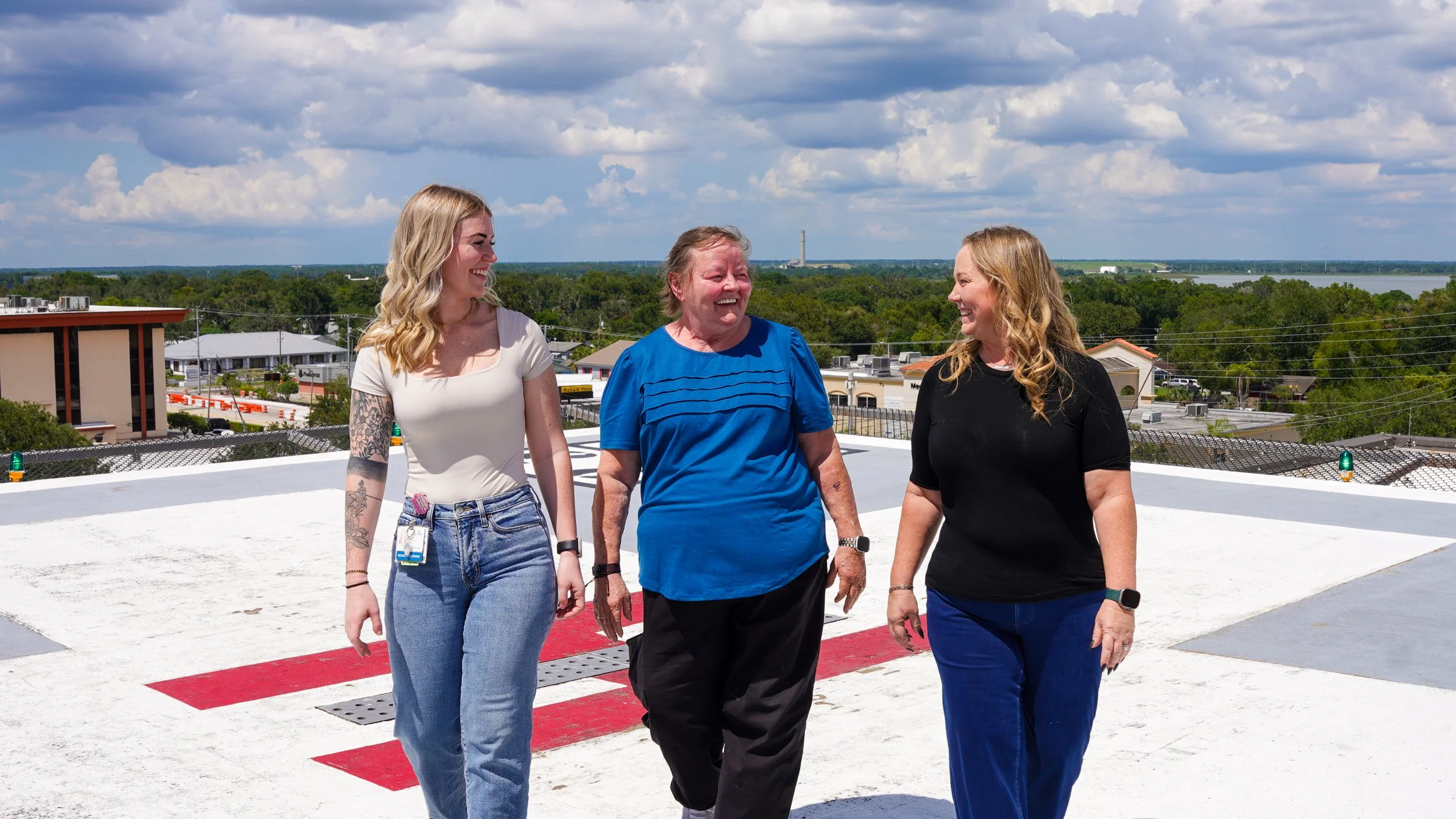
Sue Koepfle remembers the morning of Jan. 6, 2017, like it was yesterday. She had recently retired and was happily preparing to celebrate her son Joe Koepfle’s wedding in just two days. She went over to his house to pick up his suit so she could make some alterations—a simple task for an accomplished seamstress. He planned to come by later to pick it up.
Knowing the whole family would be around for dinner, she ordered a pizza. She jumped in her truck to pick it up, but she dropped something on the floorboard and looked down for a split second.
She felt the truck lurch right, then left.
She thought, “Not my new truck!” She vaguely recalls yelling for help.
The next thing Sue remembers is waking up in a hospital bed with her son standing over her. She apologized for disrupting his plans and said, “Please don’t postpone the wedding because of me!”
Joe responded gently, “Mom, that was two months ago.”
LOST TIME
Sue’s truck had clipped a guardrail on the right, then swerved left, rode along the guardrail, lost a wheel, and then flipped upside down. Firefighters used the Jaws of Life to cut her out of the truck, and she asked the EMTs to call her husband, Michael.
Meanwhile, Joe had been trying to call her. After failing to reach her, he also called his sister, Sara Richards, and their dad. He finally drove toward her house and was horrified when he came around a curve and saw the truck. Sue was not in it. She had already been taken to Lakeland Regional Health.
LRH’s Trauma Center has provided advanced, multidisciplinary care for severely injured patients since 1997. Earlier this year, the state designated it a Level I Trauma Center, the highest designation for trauma care, which means families don’t have to leave the county to be close to loved ones while they recover.
LRH’s trauma team brings together highly specialized medical professionals and advanced technology to provide lifesaving, rapid resuscitation and care for more than 4,700 trauma patients annually.
Dr. Debra Seoane, one of the trauma surgeons who cared for Sue after her accident, says, “What I like about how we function as a team is that we take the patient through the entire process, from the time we meet them in the ER to the follow-up with them after discharge in the office.”
Sara describes the days after Sue’s accident as a roller-coaster of emotions, but the one constant was the support the family received from the trauma team. Sue coded multiple times and had to be resuscitated. She was on a ventilator and was put on dialysis multiple times. Her family was told she had a 20 percent survival rate—and that if she survived, she might never be herself again.
Sue remembers none of it, because she was in a coma for two months. Later, however, she read Sara’s journals and learned some of what she and her family had gone through.
“I thought, ‘Wow!’ I couldn’t believe the care I had gotten or the compassion they had shown my family,” Sue says.
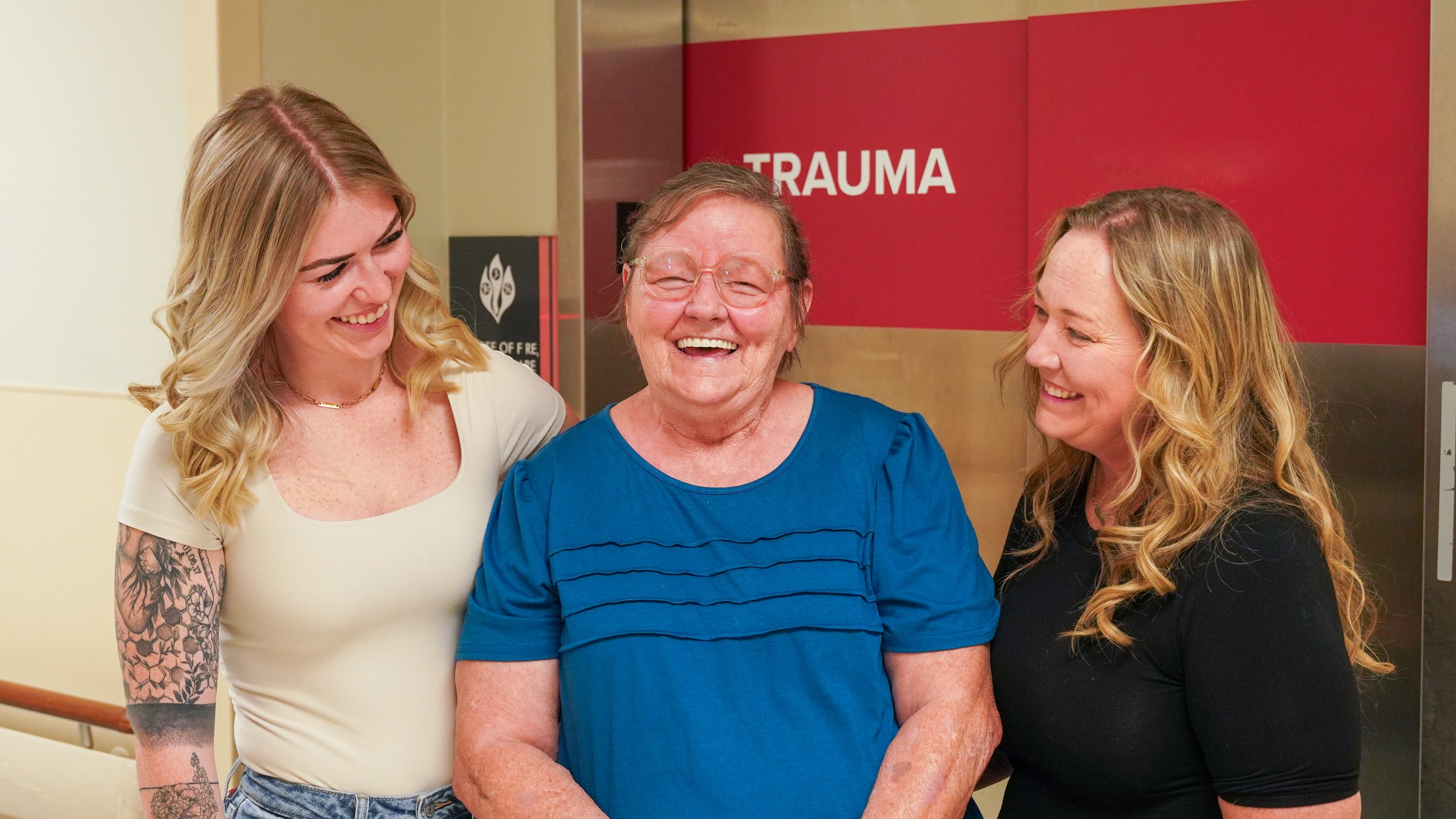
Sue Koepfle (middle) and her granddaughter, Cora Richards, (left) and her daughter, Sara Richards, (right) all celebrate the recovery Sue made from a devastating accident in 2017.
LEARNING TO LIVE AGAIN
After 69 days in the Trauma Unit, Sue was moved briefly to a long-term acute care facility long enough to be weaned off the ventilator. She then returned to LRH’s Bannasch Institute for Advanced Rehabilitation Medicine.
“Every person at Bannasch was amazing,” Sue says. “And whenever the nurses from the Trauma Intensive Care Unit (TICU) heard I was at Bannasch, they came up to visit me.”
By May, Sue was ready to leave the hospital. Because her husband was still working and she needed round-the-clock care, she went home with Sara and Sara’s daughter, Cora Richards, who was 15.
Sue had cared for her mother after she suffered a brain hemorrhage when Sue was just 14, so she knew caregiving would be hard on Sara. However, Sue did not expect the impact that it would make on Cora, who eventually decided to become a trauma nurse.
“The thing that inspired me the most was seeing how well the TICU team of nurses, doctors and others worked together to care for my grandmother,” says Cora, who is now a registered nurse in the TICU. “The rapport they built with my family, especially my mom and grandfather, is what I aspire to build with my patients’ families, because I understand what it’s like to be on the other side of the room.”
AT LAST, A WEDDING
In September 2017, Sue’s family threw a huge party to celebrate her 64th birthday. She used a walker to enter the room, amazing the whole group.
But a bigger celebration was on the horizon, and Sue was determined not to use the walker for that one. Joe’s wedding had been postponed for an entire year, and Sue, a notary public, was set to perform the ceremony on January 7, 2018.
She walked down the aisle on her husband’s arm to perform the long-delayed wedding. A month later, Sue was finally back in her own home with her husband and their dogs.
“I had lost a whole year of my life, most of which I don’t remember,” Sue says. “But I finally felt like it was going to be OK.”
Today, Sue is back to fully enjoying her life and family—making quilts and crafts, baking tons of cookies for her friends in the TICU, loving on her dogs as well as other dogs—despite some lingering neuropathy in her hands and feet.
She looks forward to continuing to share her story, including at LRH’s annual Trauma Symposium.
“I believe God still has plans for me. Maybe I’m supposed to tell my story to encourage others who suffered a terrible trauma to keep going until they get their lives back, too. It’s hard, but it can be done. Never give up—just like the TICU never gave up on you.”
Lakeland Regional Health Trauma Services
mylrh.org/trauma-services