
A Legacy Built on Compassion
How a Family-Owned Business Has Become a Beacon for Senior Care
PHOTOS BY JORDAN RANDALL AND PROVIDED BY HELPING HAND NURSING SERVICES | DEVELOPED IN PARTNERSHIP WITH HELPING HAND NURSING SERVICES
The story of Helping Hand Nursing Services can be seen and understood better than it can be explained. It’s found in a quiet moment at a kitchen table, where a wife discovers peace because someone finally answered the phone with a solution instead of a script. It’s found in the legacy of a businessman who believed that if you took care of people, the business would take care of itself.
For more than 30 years, Lakeland-based Helping Hand Nursing Services has served as a beacon for families navigating the often-treacherous waters of senior care. Founded in 1993 by the late James Gold and his wife, Marla, Helping Hand never aimed to be a juggernaut of the healthcare industry. It was, and remains, a family effort built on a foundational belief: that quality care depends on the quality of the assessment, the heart of the caregiver and a shared plan that is put into action.

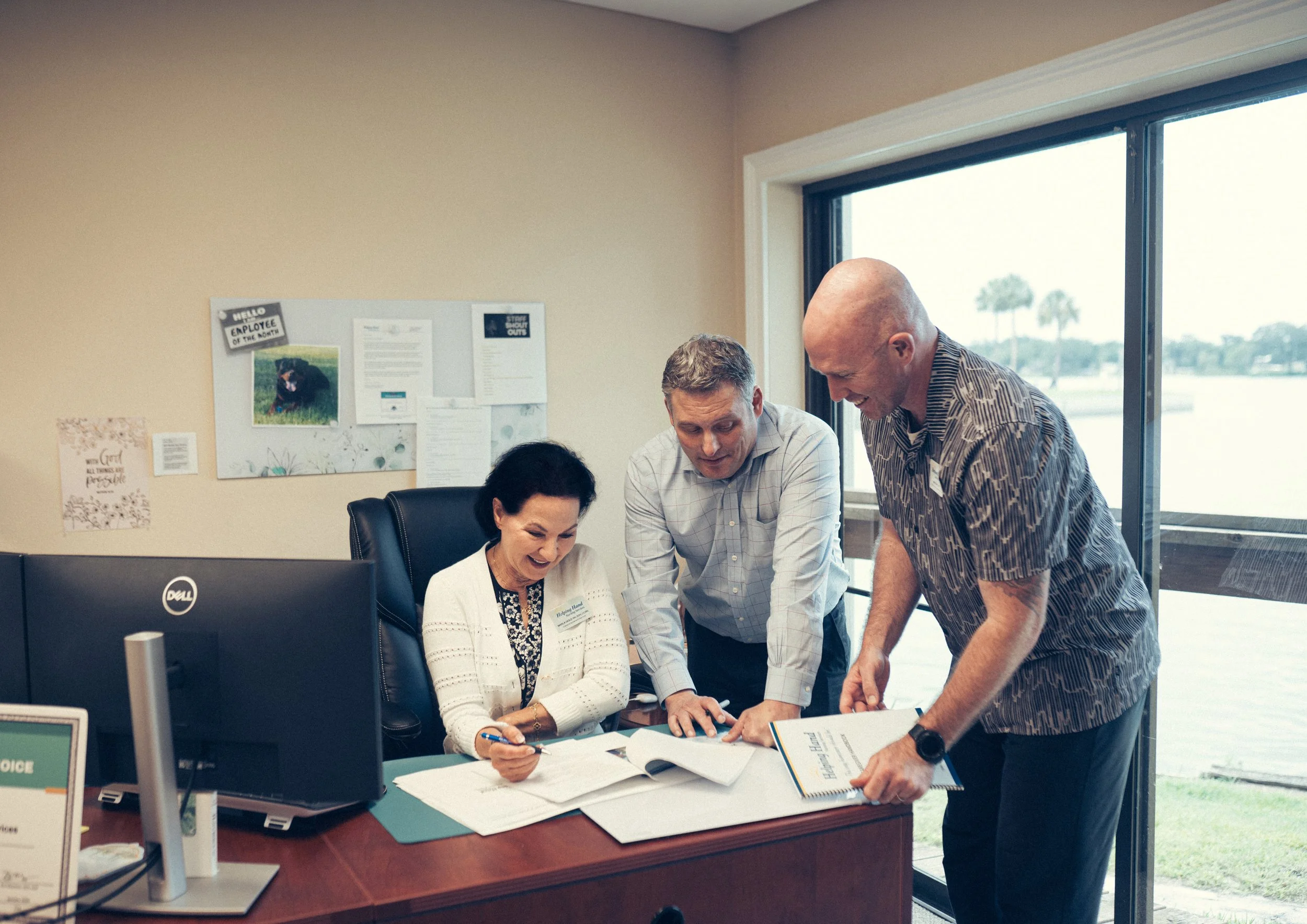
Marla Gold and her son, Justin, continue the legacy of compassionate care that began in 1993 when Marla and her late husband, James, founded Helping Hand Nursing Services.
THE BIRTH OF HELPING HAND PHILOSOPHY
James Gold was never just an administrator; he was a connector. Before he ever laid the foundation for Helping Hand in Lakeland, life had taken him from the stages of New York, where he trained as an opera singer at Curtis and Juilliard, to the fast-paced world of Los Angeles. But his journey wasn’t defined by the spotlight—it was defined by his immense, compassionate heart.
His path to founding Helping Hand was forged through the fire of personal experience.
When James and Marla—a trailblazing nurse who at one time had managed Los Angeles’ largest intensive care unit—faced the task of finding dignified care for Marla’s aging great-grandparents in Delaware, they encountered a broken system. They saw facilities that lacked humanity and a care environment that felt transactional rather than transformative. James and Marla knew there had to be a better way.
“I went around looking at all the nursing homes...and first of all, they didn’t even ask who I was. I just walked right in,” Marla recalls. When she finally stepped into a room, she found a patient who hadn’t been checked on in hours. She actually helped the patient, and then processed the moment as a wake-up call. “I went at that point to my mother and said, ‘This will never do.’”
Marla and her family decided to hire their own nurses and CNAs to help her great-grandparents. It was the birth of a philosophy: if the system won’t provide the level of dignity and medical attention your family deserves, you build a better system.
When Marla and James moved to Florida, that philosophy traveled with them. James, whose professional opera career had been derailed by health complications, possessed a unique, God-given gift for connection. He wasn’t just the operational backbone; he was the heart. He visited clients, interviewed caregivers and answered phones.
Those who knew James best would likely describe his personality as magnetic. After meeting him for just five minutes, people often felt as if they had known him their entire lives.
There is a legendary story about the early days that still circulates in the office. When James decided to raise caregiver wages a local banker warned that move would bankrupt the company. James simply replied, “If the Lord has us in the right place, it’ll work out.”
Even in his later years, as he battled his own health challenges—including a long, difficult journey with a misdiagnosed illness—his spirit remained focused on others. He used his business not as a vehicle for wealth, but as a ministry of service. He wasn’t just building a company; he was building a sanctuary for families navigating their most treacherous waters.
THE “NURSE GUIDED” DIFFERENCE
In an industry crowded with homemaker agencies and large franchises that treat senior care like a check-box exercise, Helping Hand stands apart through its “Nurse Guided Home Care” model.
“Most home care is basically four-hour cases here and there,” explains Marla’s son, Justin Gold, owner and president. “But you have about 20 percent of the population who have just run out of the hospital with comorbidities...and if you don’t have a nurse really doing the assessment and developing the care plan with the medical knowledge, the person is not going to improve.”
This model is the bridge between a crucial gap in the healthcare system and strives to achieve the goal of helping people age in place more effectively. Whether a client is struggling with COPD, heart disease, Alzheimer’s or recovering from a stroke, the team at Helping Hand doesn’t just send a sitter. They perform a clinical assessment. They create a plan. They advocate for the patient.
“It’s not like they’re talking to the caregiver like a boss,” Justin says of his team. “They’re working with them... because in every situation we’re here to help.”
Patients know what they are getting with Helping Hand thanks to a flat fee of $25 per hour for CNA/HHA care, as well as a team to help file insurance claims.
PEACE IN THE STORM
For families in crisis, the Helping Hand community often feels like a port in a storm. Kevin Curtin, the director of marketing and assistant administrator, recalls a recent interaction that highlights exactly what sets them apart. A woman, exhausted from dealing with three different agencies that provided no structure, called in a state of desperation, fearing her husband wouldn’t last the week.
“I said, ‘Give me 30 minutes,’” Kevin recounts. He found a highly credible, experienced caregiver, and assured the wife that they could start immediately. “You could just hear the ‘whoosh’ of peace in the storm. Jesus walked out to the top of the ship and said, ‘Peace, be still.’ You could hear that in her voice.”
This isn’t just business, it is ministry. The leadership team at Helping Hand makes no secret of their faith. From the Bible verses on the walls to the way they pray with clients, it is an integral part of their DNA.
“It’s so important no matter what you believe or how you believe, there’s some way you can always comfort someone with God,” Marla says.
“You have about 20 percent of the population who have just run out of the hospital with comorbidities...and if you don’t have a nurse really doing the assessment and developing the care plan with the medical knowledge, the person is not going to improve.”
AN EXTENSION OF FAMILY
One of the greatest testaments to the culture at Helping Hand is the longevity of its registered nurses. In an industry where 70 percent turnover is common, Helping Hand boasts a roster where 70 percent of caregivers have been with them for more than a year, with some serving for decades.
There is a family who has had the same Helping Hand caregiver for 24 years. There is a case where a grandmother, her daughter and her granddaughter have all worked for Helping Hand as well. It’s an “extension of our family,” as Justin puts it.
When you see Marla in the grocery store or at church, people don’t just see a business owner—they see the person who was there during their darkest, most intense moments of need.
As they look toward the future, the goal remains unchanged: to grow slowly, to grow well and to never lose the “small-town” mindset that allows them to customize care for every individual.
They aren’t trying to conquer the market; they are trying to provide a solution for the anxiety of families who simply need to know their loved ones are safe.
After 33 years, the Helping Hand name is more than a label—it is a promise. It is the legacy of James and Marla Gold, a testament to the idea that if you care for the people, the mission will never fail. As Marla often reminds her team, you don’t choose this work—it chooses you. And for the families of Polk and Hillsborough County, that choice has made all the difference.