
How the Chamber Cultivates Relationships That Help Free Enterprise Thrive in Lakeland
PHOTOS BY JORDAN RANDALL
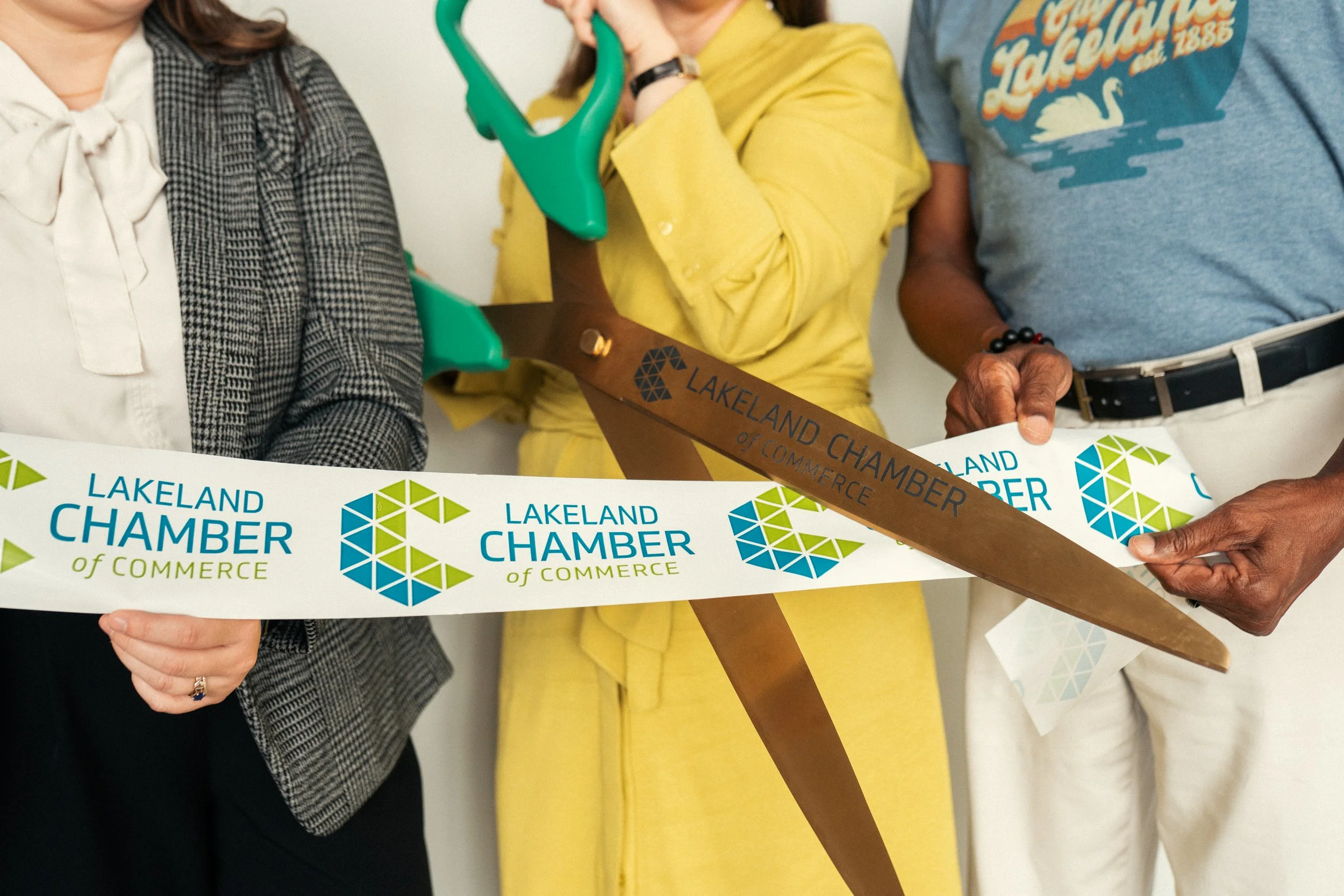
If you were to conduct a straw man poll on Main Street about what a Chamber of Commerce does, you would likely get a standard array of imagery: oversized ceremonial scissors, crisp name badges, early-morning coffee mixers, and perhaps a stack of community magazines or brochures. It’s easy for these visible traditions to be the fullness of what outsiders — and even business owners — understand about institutions that have been embedded in community life for decades, or in the case of the Lakeland Chamber of Commerce, 105 years. But peel back the curtain, step past the ribbon cuttings, and sit at the table during a strategic retreat or immerse yourself in a local leadership group operated by the Chamber and you will discover a more extensive reality.
In an era dominated by hyper-efficient digital tools, instant communication and algorithmic networking, the Lakeland Chamber of Commerce is undergoing a quiet, yet intentional evolution. It is no longer solely a convener or an event planner — although the Chamber prides itself at being top-notch at both. It functions as an incubator of relational equity, a place where real human connection can be converted into long-term economic resilience.
CUTTING THROUGH THE NOISE
People in our culture are obsessed with instantaneous results. An entrepreneur can buy a targeted ad, launch a website, and have their products shipped to mailboxes in no time. And they should. But as any seasoned business owner will tell you, early success or online activity does not automatically build a sustainable enterprise. In fact, the sheer volume of people trying to turn a quality product or service into a long-term business by following the advice of influencers often leaves leaders feeling isolated in an echo chamber, staring at computer screens and hoping for traction.
Amy Wiggins, President and CEO of the Lakeland Chamber of Commerce, sees this dynamic playing out every day. When discussing the modern value proposition of joining a local chamber, she cuts straight to the relational foundation that no digital tool can replicate.
“You can go read a hundred blogs and they can tell you a hundred different ways to do something,” Wiggins explains. “The great thing about being a part of the Chamber is that you’re connecting directly with real flesh-and-blood people who genuinely care about your success, genuinely care about the impact that you’re making on Lakeland. That’s really the superpower that we have: translating business knowledge into lasting relationships.”
That superpower has the potential to be more potent than ever if wielded with communal success in mind. Consider this: Florida’s economy is slightly larger than the entire country Australia’s. What are local business owners and leaders looking for as they traverse that landscape?
In annual member surveys across the Chamber’s 1,200 member businesses, an astounding 95 percent report that their revenues are maintaining or growing. Yet, when asked what the Chamber’s board and staff should prioritize most, the answer is uniform: businesses want assistance with talent development and retention.
Dr. Takiyah Dixon, the Chamber’s Director of Business Resources and Director of Leadership Lakeland points out that traditional hiring methods that rely strictly on formal degrees or rigid job titles are increasingly giving way to skills-based hiring and talent pipeline management. By partnering with regional institutions like Polk County Public Schools, Polk State College, Florida Southern College, Southeastern University, ConnectED Polk and CareerSource Polk, the Chamber helps businesses articulate their exact competency needs directly to educators, creating clear pathways for students before they even graduate.

Kaleigh Avian, Board Member and Past Chair of EMERGE Lakeland (left), Amy Wiggins, President & CEO (middle), Phillip Walker, VP, Partnerships & Research (right)
FREE ENTERPRISE VS. THE ENTREPRENEURIAL SPARK
In recent years, “entrepreneurship” has become the buzzword of choice across the globe, including Central Florida. Incubators, co-working spaces, and pitch competitions have rightfully celebrated the brave innovators disrupting traditional models. But Wiggins offers a crucial distinction between the spark of individual entrepreneurship and the broader health of free enterprise.
Lakeland, as Wiggins points out, is uniquely structured to support the entire lifecycle of business. Consider this scenario: An innovator has a disruptive idea — say, revolutionizing the way gourmet snacks are made. They start at the Chamber, where they are guided toward the Small Business Development Center to craft a viable business plan. Once launch-ready, they move into Catapult’s shared kitchen or workspace. As the company takes root and hires its first few employees, the owner returns to the Chamber network to find local accountants, legal counsel and insurance partners. When the company outgrows Catapult, the Lakeland Economic Development Council steps in to help secure commercial real estate and bolt manufacturing equipment into the floor — making them permanent fixtures of the local landscape.
Years later, a veteran employee from that same company decides to branch out with their own venture, and the cycle begins anew. “Entrepreneurship is not one and done; it is a constant cycle,” Wiggins notes.
FACING ECONOMIC REALITIES HEAD-ON
Operating a small business in 2026 comes with headwinds. National data from the U.S. Chamber of Commerce reveals that inflation remains the primary obstacle for more than half of small business operators, followed closely by supply chain friction, revenue volatility and the rising cost of employee healthcare. Locally, Lakeland business owners are grappling with compounding uncertainty around affordability, talent retention and infrastructure development.

Kassia Alamm, Director of Strategic Communications and Public Affairs
Dixon spends her days in the trenches with emerging and established business owners. Her message in the current economic climate is rooted in strategic adaptability.
“Today’s business environment requires more than having a great product or service,” Dixon emphasizes. “It requires understanding your market, managing resources effectively, investing in your people, and being willing to evolve. We encourage businesses to shift from reactive to proactive — building the capacity to respond to tomorrow’s opportunities rather than simply surviving today’s challenges.”
BRIDGING GENERATIONS: MENTORSHIP AS AN
ECONOMIC ENGINE
Some of the most vital work happening within the Chamber today is the intentional bridge-building between generations of leaders. Legacy business owners who have spent decades building local institutions possess an immense wealth of institutional knowledge. Meanwhile, young professionals bring fresh perspectives, technological fluency and new energy.
Tony Johnson, a Chamber board member, owner of Ignite Your Service, and co-owner of 4xi Global, views the Chamber as an irreplaceable aggregator that brings people together. Having traveled the country as a keynote speaker and consultant, Johnson has seen many civic organizations fade or lose their edge. In Lakeland, however, he sees a culture of accessibility that empowers young leaders to step up.
“This is the most open Chamber I have ever seen,” Johnson says. “You go to any ribbon cutting, the CEO of the Chamber is there, open for a real conversation. Mentorship often happens organically, but good organizations create a landscape where connection isn’t left strictly to chance.”
A prime example of this structured connection is EMERGE Lakeland, a network for driven young professionals created in partnership between the Chamber and the United Way of Central Florida. EMERGE serves as a launchpad for young leaders seeking both professional growth and philanthropic impact.
Kaleigh Avian, a Chamber board member, Past Chair of EMERGE, and Community Partnerships Specialist at Publix Employees Federal Credit Union, credits this intergenerational ecosystem with transforming her career trajectory. Growing up in the area but attending high school in Bartow, Avian returned to Lakeland seeking a cross-industry network. She audited EMERGE committee meetings, volunteered for event planning, and immersed herself in the community.
While presenting a strategic update to Chamber program sponsors in 2025, representatives from Publix Employees Federal Credit Union were in the audience. Impressed by her leadership and passion for community advocacy, they recognized her potential for an open position that bridged corporate resources with local philanthropy—an opportunity Avian says she never would have found through a traditional job board.
“EMERGE puts young people in seats they otherwise would not have an opportunity to sit in,” Avian reflects. “When you work collaboratively on shared community goals, you build deep trust. That trust naturally leads to business referrals down the road, but it starts with building genuine friendships and a shared commitment to Lakeland’s future.”
In hopes of normalizing outcomes like hers, the Chamber and EMERGE recently announced The EMERGE Mentorship Program, a six-month experience that will connect 10 young professionals with established business and community leaders in Lakeland for meaningful, one-on-one mentorship.
“We encourage businesses to shift from reactive to proactive—building the capacity to respond to tomorrow’s opportunities rather than simply surviving today’s challenges”

Dr. Takiyah Dixon, Director of Business (left) and Monica DiNicolantonio, Director of Membership (right) make sure members are provided every resource and opportunity possible to succeed.
A TRUE R.O.I.
For business owners weighing where to allocate scarce marketing and operational dollars, joining a chamber can sometimes feel like a leap of faith. Marketing and networking are inherently lagging indicators; buying a piece of kitchen equipment or new machine yields an immediate physical asset, whereas cultivating relationships requires patience, presence, and intentionality.
Tony Johnson cautions new business owners against viewing chamber membership as a passive badge for the front door. “You get out of it what you put into it,” Johnson notes. “Don’t try to do everything, but sit down with the Chamber staff, be honest about what you are trying to accomplish, and build an intentional plan. Whether it’s leveraging the digital authority and Google backlinks that come with a Chamber directory profile, attending specialized leads groups, or participating in policy discussions, treat it as an active part of your business strategy.”
Johnson is one of 40 members on a board that is diverse in title and industry and broad in thought. He notes that a lot of entrepreneurs and business leaders have good products, but unlocking purpose usually takes time, trial and error, something board members have loads of experience with.
“For restaurants...it’s not about the cheeseburgers. It’s about feeding the people. It’s about feeding the community. Auto dealers are selling transportation, not cars. Banks are selling home ownership and security, not just a bank account. And when you understand that larger purpose and what your customers or your guests are trying to accomplish, that just makes you a powerhouse.”
The chamber offers a rare space where small boutique owners, corporate executives, educators, and municipal leaders sit side by side to solve regional problems — from infrastructure needs to early childhood literacy and housing for an expanding workforce.
“One of the best examples (of how people navigate life together) is when Chamber members meet at an event and realize they’re facing similar challenges, whether it’s hiring employees, attracting customers, or growing their businesses,” says Monica DiNicolantonio, Director of Membership at the Chamber. “Those conversations often lead to shared resources, referrals, creative partnerships, and new opportunities they might not have found on their own.”