Dr. Kelly Koch
Surgical Oncology, Lakeland Regional Health
Dr. Manuel Alberto Molina-Vega
Surgical Oncology, Lakeland Regional Health
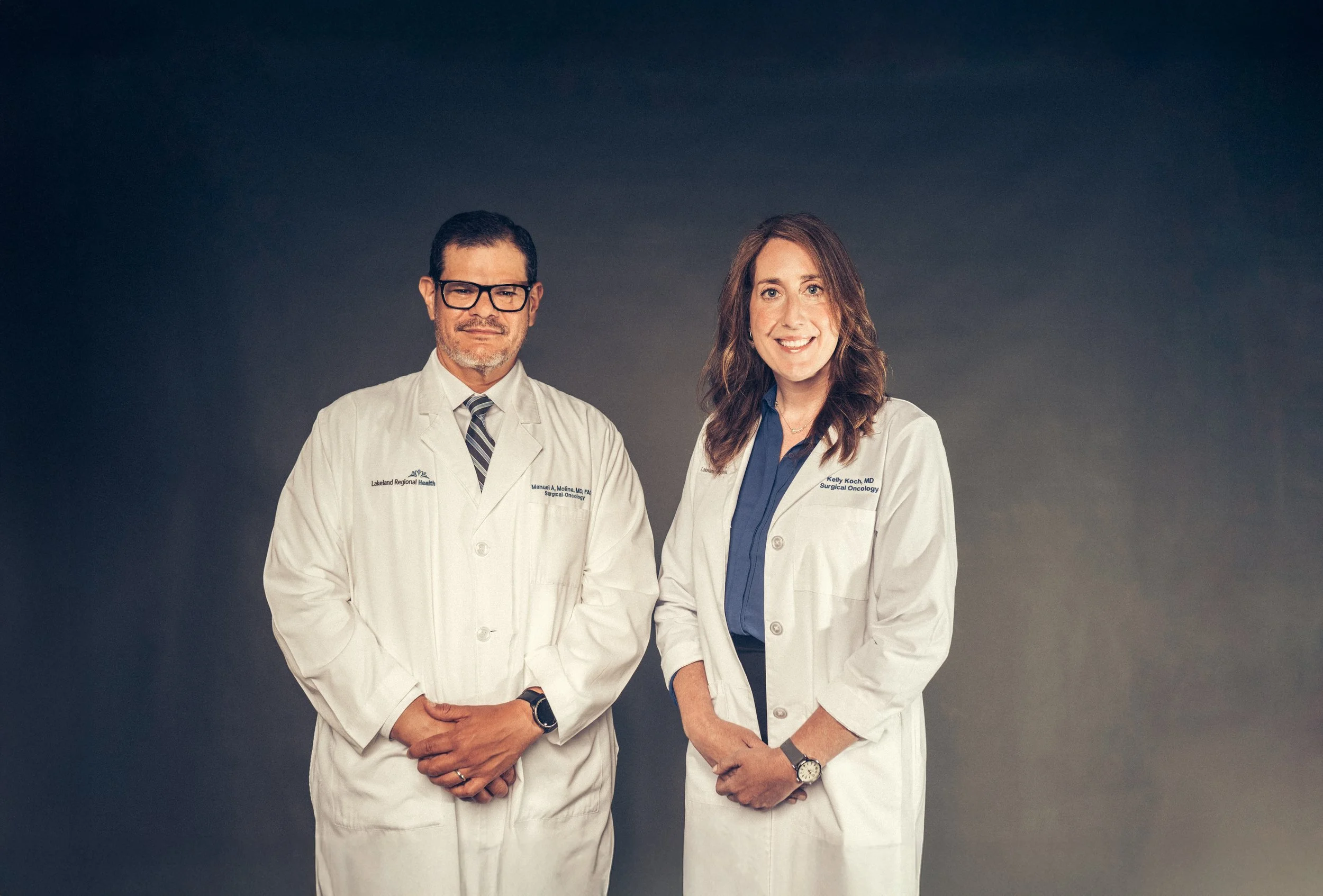
Dr. Manuel Alberto Molina-Vega and Dr. Kelly Koch know the complex and lengthy names of countless types of cancers and diseases, but the most important names to them are of the patients they passionately serve, who are often on uncertain and scary paths involving cancer.
At Lakeland Regional Health, the surgical oncology team is led by Molina-Vega’s and Koch’s complementary expertise and embodies a human-centered approach where the team is very sensitive to its role and committed to doing everything it can to improve outcomes.
“What drives me to keep doing this 24/7 is to…take a tumor out, put everything back together and help patients feel well,” Dr. Molina-Vega says.
He initially took a liking to the medical field when was fascinated as a teenager by what he was learning in his high school science class, and now he is an 18-year veteran in surgical oncology, 16 of which he has served patients at LRH.
He was initially drawn to Lakeland by the sheer volume of patients it served in its emergency room and the evident need for more specialized cancer care doctors in the community. Having come from an academic background at the University of Miami, he aimed to continue his research in GI cancer, but what kept him in Lakeland was the palpable sense of community and the opportunity to build something truly special.
“I really felt that I was helping the community that needed it,” he reflects “And once people started to realize what we have here in the [Hollis Cancer Center] it made it easy to recruit.”
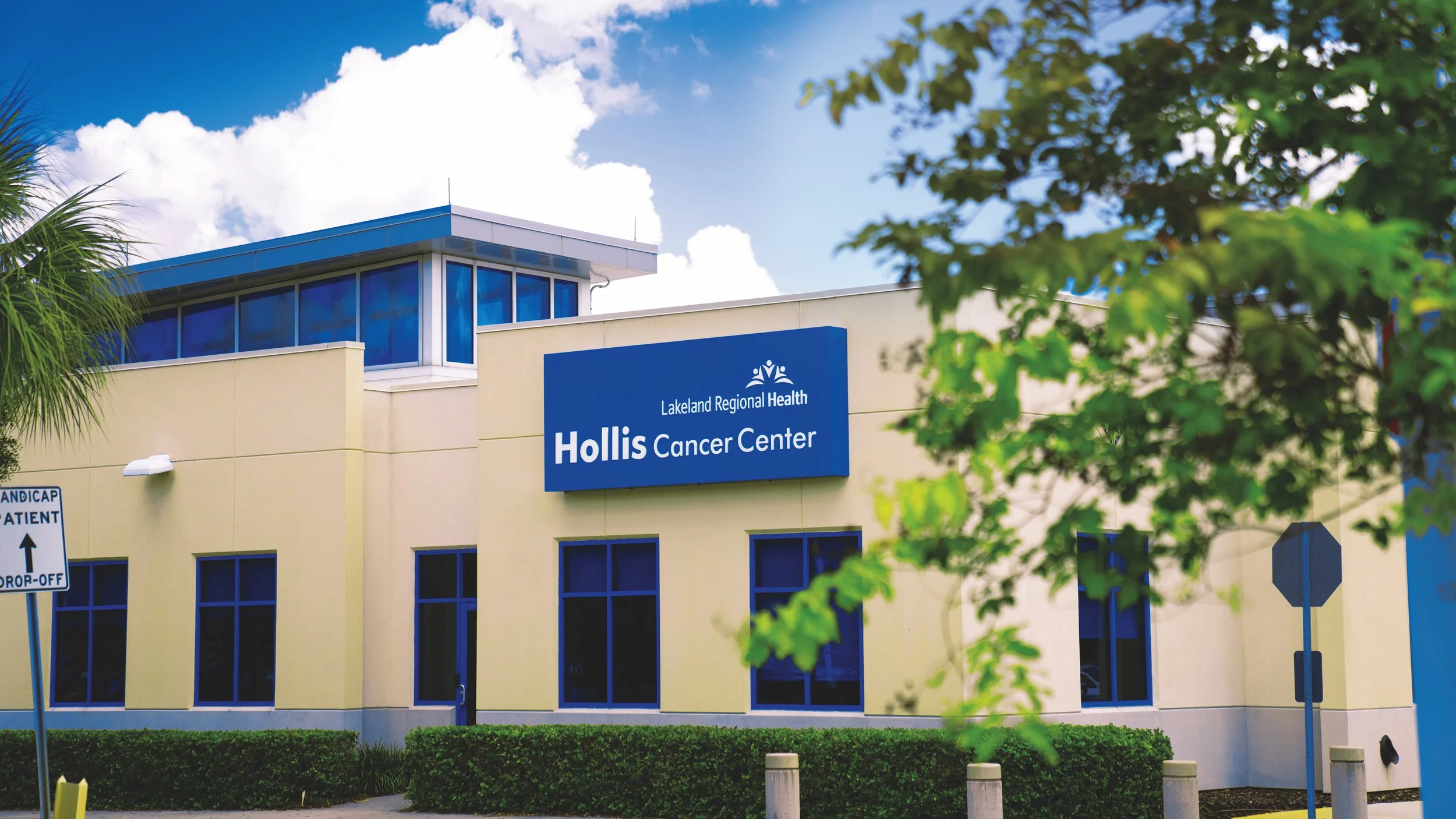
It’s no surprise to Dr. Molina-Vega that Hollis Cancer Center, which opened in 2003, was named one of 24 oncology programs in the country to earn the Outstanding Achievement Award from the Commission on Cancer, because its foundation was built by a team of founders who came from major cancer centers from around the United States with a multidisciplinary mindset.
Dr. Koch, who is approaching two-year anniversary at LRH, chose Lakeland for a compelling reason that mirrored Dr. Molina-Vega’s when he chose to become a Lakelander: the opportunity to make a significant impact. Having trained in the large metropolitan setting of Jackson Memorial Hospital Miami, she sought an environment where her contributions would truly resonate.
“Coming to be the second person [at LRH] doing what I did felt like I had a lot more to add,” she explains. Her path to oncology surgery was an evolution, shifting from a focus on cardiac surgery due to what she calls “her enjoyment of abdominal procedures” and a desire for more enduring patient relationships.
“It is really amazing how much of your body is redundant and how much you can live without,” she says. “And you put a tumor just dropped in the middle of the abdomen and you’re given a challenge of how to get that out, and then how to repurpose different parts of the abdomen so that all of the daily functions, or at least enough of them can be rebuilt so that you can live your life without the tumor and whatever was touching it.”
She finds deep satisfaction in both curative and palliative care, recognizing the profound privilege of guiding patients through critical moments in their lives, whether assisting in recovery or providing comfort at the end of life.
Dr. Molina-Vega was ecstatic to have Dr. Koch join the ranks with him a couple of years ago, the latest expansion for a department that is focused on constantly learning and innovating.
Over the years, the surgical oncology team has initiated multidisciplinary conferences for complex cases, fostering crucial collaboration with interventional radiology, a group that has since become a regional leader.
The integration of dedicated support staff further distinguishes their patient-centered model. Thomasina Alvarez, a former PACU nurse, now serves as a patient navigator, providing direct access and expediting appointments with other oncology specialists. Jamie Sites is an experienced social worker who screens for and addresses patient barriers such as transportation or insurance.
Clinical trial personnel pre-screen patients for access to cutting-edge research. Recognizing the unique challenges faced by GI cancer patients, the team implemented early nutrition screenings and dietitian referrals, alongside preconditioning and pre-rehabilitation programs.
This holistic approach ensures patients are optimally prepared for treatment and recovery.
Speaking about LRH’s personalized approach, Dr. Molina-Vega says, “We know them by their first name.”
He points to LRH’s high patient volume and participation in major multi-institutional trials, alongside renowned institutions like Moffitt and UF, as testaments to their quality and outcomes. LRH was even a pioneer in robotic surgery before many larger centers, consistently offering the latest advancements and minimally invasive techniques.
As Dr. Koch aptly puts it, “If you see one of us, you see both of us,” highlighting the seamless collaboration that combines Dr. Molina-Vega’s extensive experience with Dr. Koch’s fresh perspective and enthusiasm.
Both doctors offer profound insights into understanding the root causes of cancer and how to prevent it.
Dr. Koch often addresses the patient’s common question, “What did I do wrong?” by emphasizing that cancer is multifactorial—a complex interplay of genetics, environmental factors, and sometimes, simply bad luck. Her hope is to release guilt and focus on moving forward with treatment, knowing that even with the best efforts, cancer can still occur. Dr. Molina-Vega stresses the importance of not ignoring symptoms and seeking professional help rather than self-diagnosing online.
He advocates for lifestyle changes—cessation of smoking and excessive drinking, regular exercise, and maintaining a healthy weight. He also underscores the critical role of regular screenings, such as colonoscopies and mammograms, and genetic testing when family history suggests a predisposition.
“What drives me to keep doing this 24/7 is to…take a tumor out, put everything back together and help patients feel well.”